
U.S. States With the Highest Tax Burden in 2026
Where Americans live can make a substantial difference in how much of their income goes toward state and local taxes.
Jonathan Williams, Chief Economist at the American Legislative Exchange Council, once observed that your state tax burden is actually best considered as the price the state is charging you just to live there.
This map compares tax burdens across all 50 states using 2026 figures from WalletHub.
Total tax burden combines property, individual income, and sales and excise taxes as a share of personal income, excluding federal taxes.
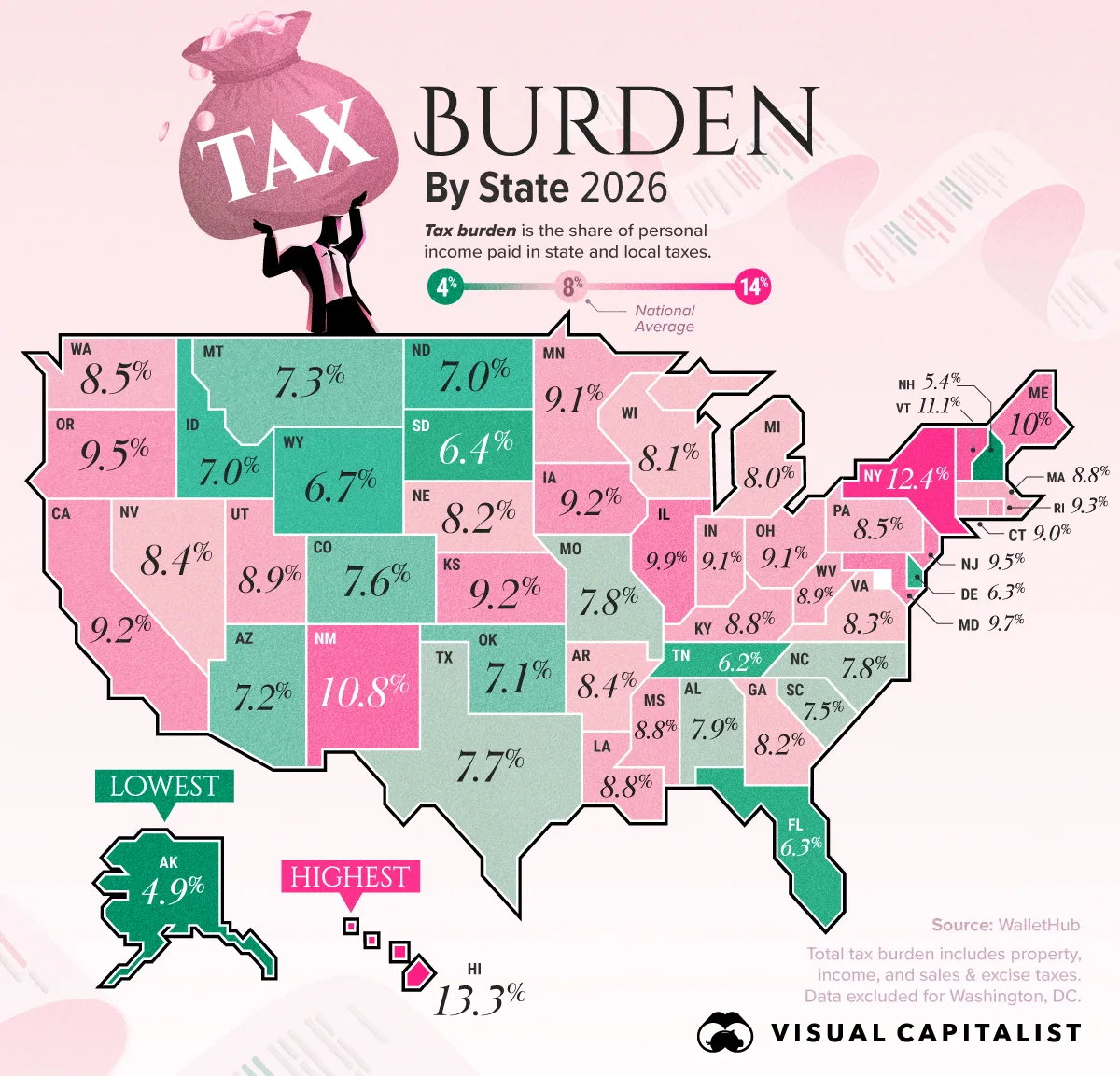
Nationwide, the average tax burden is 8.43%, but states differ considerably in both how much they collect and which taxes account for the largest share.
Where Tax Burdens Are Highest and Lowest
The difference between the highest- and lowest-tax states is substantial: Hawaii’s tax burden of 13.30% is nearly three times Alaska’s 4.92%, highlighting how differently states fund public services.
The Northeast accounts for half of the 10 highest tax burdens, while New Mexico stands out at 10.75%, among the highest outside the region. New York State is second highest at 12.39%, where the state takes one dollar out of every eight dollars earned by its taxpayers.
Beyond the highest and lowest rankings, the map reveals striking regional contrasts. On the West Coast, income taxes contribute the largest share of Oregon’s burden, while Washington relies more heavily on sales and excise taxes.
Hawaii’s Steep Tax Bill at 13.3%
Hawaii’s position at the top of the ranking is driven largely by consumption-related taxes, which account for more than half of its total burden. Unlike a conventional retail sales tax, Hawaii’s broad general excise tax applies to business receipts from goods, services, construction, and rent, not just profits.
Wholesalers and retailers can both owe the tax, meaning a product can generate tax revenue at multiple stages before reaching the final buyer. Renters can encounter it as well. Landlords owe general excise tax on rental receipts and may pass that cost on to tenants. The tax therefore affects both everyday purchases and housing payments.
Alaska’s Resource Wealth Helps Pay the Bills at 4.92%
Alaska levies neither a personal income tax nor a statewide sales tax, although municipalities can collect local taxes. The state also benefits from an unusual funding source: an investment fund built largely from oil and gas revenues. The Alaska Permanent Fund invests a share of the state’s mineral revenue, turning finite natural resources into a source of ongoing investment income.
New Hampshire has the second lowest tax burden at 5.38%
The legislative strategies of Republican majorities in office for the past six years in Concord, combined with a Republican Governor for the last eight years, have successfully kept the state of New Hampshire in the forefront of minimizing the amount of income and assets the state requires from its taxpayers to support government services.
GST founder Governor Mel Thompson, who said “Low taxes are the result of low spending.” set a direction which is still supported by one of our two major political parties, the Republican Party.
That direction, being followed, has led the state to the position of Second Best in the treatment of taxpayers and respect for their income, and has resulted in net inward migration, reduced business taxes, attracting more businesses, and a growing economy.
On November 3rd, vote to keep in place the people and party that have created that successful record.
Posted by: GST Board Member Ray Chadwick
———————————————————————————————————————————-
The table below ranks all 50 states by their overall tax burden in 2026:
Rank State Overall Tax Burden in 2026 (%)
1 Hawaii 13.30
2 New York 12.39
3 Vermont 11.10
4 New Mexico 10.75
5 Maine 10.01
6 Illinois 9.92
7 Maryland 9.70
8 New Jersey 9.52
9 Oregon 9.46
10 Rhode Island 9.29
11 California 9.24
12 Iowa 9.21
13 Kansas 9.20
14 Indiana 9.12
15 Minnesota 9.08
16 Ohio 9.05
17 Connecticut 9.00
18 West Virginia 8.89
19 Utah 8.87
20 Mississippi 8.84
21 Louisiana 8.82
22 Massachusetts 8.82
23 Kentucky 8.76
24 Pennsylvania 8.47
25 Washington 8.47
26 Arkansas 8.44
27 Nevada 8.37
28 Virginia 8.26
29 Nebraska 8.16
30 Georgia 8.15
31 Wisconsin 8.12
32 Michigan 7.98
33 Alabama 7.93
34 Missouri 7.84
35 North Carolina 7.81
36 Texas 7.69
37 Colorado 7.56
38 South Carolina 7.49
39 Montana 7.29
40 Arizona 7.24
41 Oklahoma 7.05
42 Idaho 7.04
43 North Dakota 7.02
44 Wyoming 6.70
45 South Dakota 6.38
46 Delaware 6.28
47 Florida 6.27
48 Tennessee 6.21
49 New Hampshire 5.38
50 Alaska 4.92
🇺🇸 National Average 8.43
Thanks to Visual Capitalist “Mapped: U.S.States With the Highest Tax Burden in 2026”, October 9, 2026